
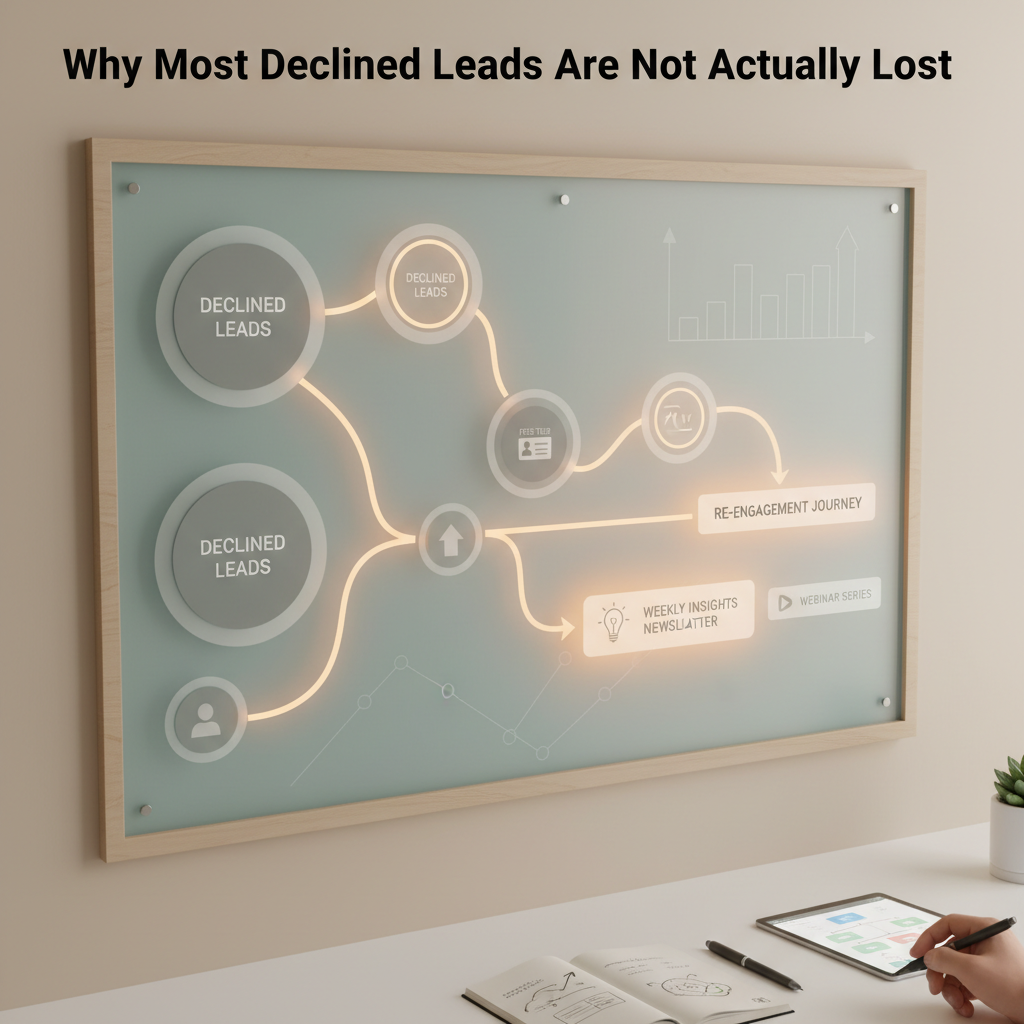
The weekly marketing review surfaced something uncomfortable: a table of leads with a red "declined" status, and it was not getting smaller. For a local service brand, nearly three-quarters of prospects who engaged with Instagram and WhatsApp ads turned down the full membership. At the same time, another spreadsheet sat half empty with leads who had said "yes" to the offer but never made it to payment. One table was full of noise, the other of quiet opportunity. The tension was not marketing spend or channel mix. It was attention. The team was chasing fresh eyes while leaving valuable heat on the table.
We looked at the data, not for vanity metrics, but for patterns of movement. Who converted after decline? Who sat in "processing" for more than 48 hours? Who responded to the second message after the first opened? The pattern was clear: the highest-ROI move was not more ad spend or better creative. It was re-engagement with the right offer, the right message, at the moment people were still warm but had not yet moved.
The difference between a decline and a yes is often not price or value. It is commitment friction. We were not selling wrong. We were asking too much at once.
A local service brand tested a three-tier entry structure: full membership, a one-session trial, and a limited-time perk (priority scheduling for the next 72 hours). They reached out to the past 90 days of decliners, not with another full bundle pitch, but with a single, low-commitment option. The trial conversion rate jumped from 12% to 38% among that list. Not because the trial was better, but because the bar was lower. We learned: a "no" today might be a "yes" tomorrow with less friction.
The real problem is not decline
The problem is not just decline. It is inaction. We found leads who had clicked "yes," filled the form, opened the confirmation email, then never paid. They were not cold. They were not confused. They just stopped.
A 24-hour fast-track follow-up (a quick WhatsApp call, personal audit, direct payment link) brought 41% of those leads to payment. The message was simple: "You said yes. Let me help you finish." No upsell. No objection handling. Just completion.
WhatsApp closed at 2.3x the rate of Instagram
Instagram was driving 3x the inquiries of other channels, which made sense. It is visual, short-form, and discovery-ready. But the WhatsApp channel, despite lower volume, closed at 2.3x the rate.
Why? A team member started routing all WhatsApp leads through herself personally. Not to pitch, but to get a quick read: "What stopped you from going further last time?" That single question surfaced three things: price sensitivity, timing, and perceived risk. The fix was not discounts. It was timing. One lead declined because the offer required a two-week advance commitment. The team offered same-week slots instead. Conversion jumped again.
Shorten the decision window
We stopped building packages and started shortening cycles. When competitors announced bundled "starter kits" and "year-long plans," our counter-move was not to match price or features. It was to shrink the decision window.
Instead of "buy now or forever pause," we created: "Reserve your spot for next week. Lock your slot until Friday. No commitment until you see the first session." That shift did not increase demand. It increased action. People bought earlier because the risk window disappeared.
Referrals without rewards
A referral prompt for existing members, deployed with zero reward, generated leads that were 3.5x more likely to convert than cold-ad leads. Not because the rewards were better, but because they came through a human voice, not a feed. "Someone I know uses this" beat "Top-rated service" every time.
The lead re-engagement checklist
Here is what we now run as a standard checklist after each lead generation cycle. Not to track volume. To flush out friction.
- Declined leads: Reach back within 72 hours with one lower-commitment option (trial, perk, shorter commitment). No re-pitching the original offer.
- Processing leads: Flag any that sit over 24 hours without action. Send a fast-track WhatsApp message with a direct link or call slot. "You started. What is left?"
- Channel quality check: Compare WhatsApp vs Instagram vs other channels not by volume, but by conversion depth. A lower-volume channel that converts faster may be the better feed.
- Commitment friction audit: For every lead that stalled at payment, ask one question: "What would have made you click today?" Do not assume. Record the actual answer.
- Referral injection: Add one prompt only to existing members: "Who would you tell if they needed this?" No reward. Just a voice. They will tag warm prospects, not just strangers.
The operator takeaway
The operator mindset is not chasing every lead. It is tending the ones already warmed. Decline is not an endpoint. It is a signal that the ask was too big. Inaction is not cold. It is a delay waiting for less risk.
We do not create more offers anymore. We test commitment size first. What is the smallest first step that proves value, moves money, and creates a reference? That step changes per audience, per product, per moment. But it is always there, visible only if you stop looking at the abandoned cart and start listening to the ones who almost got there.